
Choose a Study
Free, university-level STEM and aerospace learning in six languages. Start from first principles and work all the way to designing what flies, with every lesson tied to real work that helps people and the planet.
Choose a Study
Applied studies
- Aerospace Engineering — Rocket PropulsionThrust, Isp, the rocket equation, nozzles and engine cycles, then today’s engines, 30 years of launch footage, and where to study.1 course
How this helps the planet: Efficient engines cut fuel use and emissions; launch vehicles carry the satellites that watch oceans, forests and ice. See Sustainable Aviation and Earth Observation.
- Aerospace Engineering — Jet PropulsionA free four-year aerospace engineering path, from first calculus to a two-semester jet propulsion capstone.30 courses
How this helps the planet: Senior work turns this into design: quieter, lower-emission engines and alternative fuels (Sustainable Aviation), spacecraft for space solutions and missions for planetary defense.
- Aeronautical EngineeringThe core path: a four-year roadmap from first chemistry and calculus to designing an aircraft or CubeSat.30 courses
How this helps the planet: Propulsion and orbits are how Earth-observation satellites reach orbit to watch oceans, forests and ice. See Earth Observation and Upcoming Launches.
- Orbits & Orbital ElementsHow satellites move: Kepler, transfers, delta-v and spacecraft design.2 courses
How this helps the planet: Orbits are how we watch our planet: Earth-observing satellites in low orbits map forests, crops and water, and geostationary weather satellites watch storms around the clock. See Earth Observation.
STEM foundation
- PhysicsMotion, forces, energy, fields and waves, from first principles.2 courses
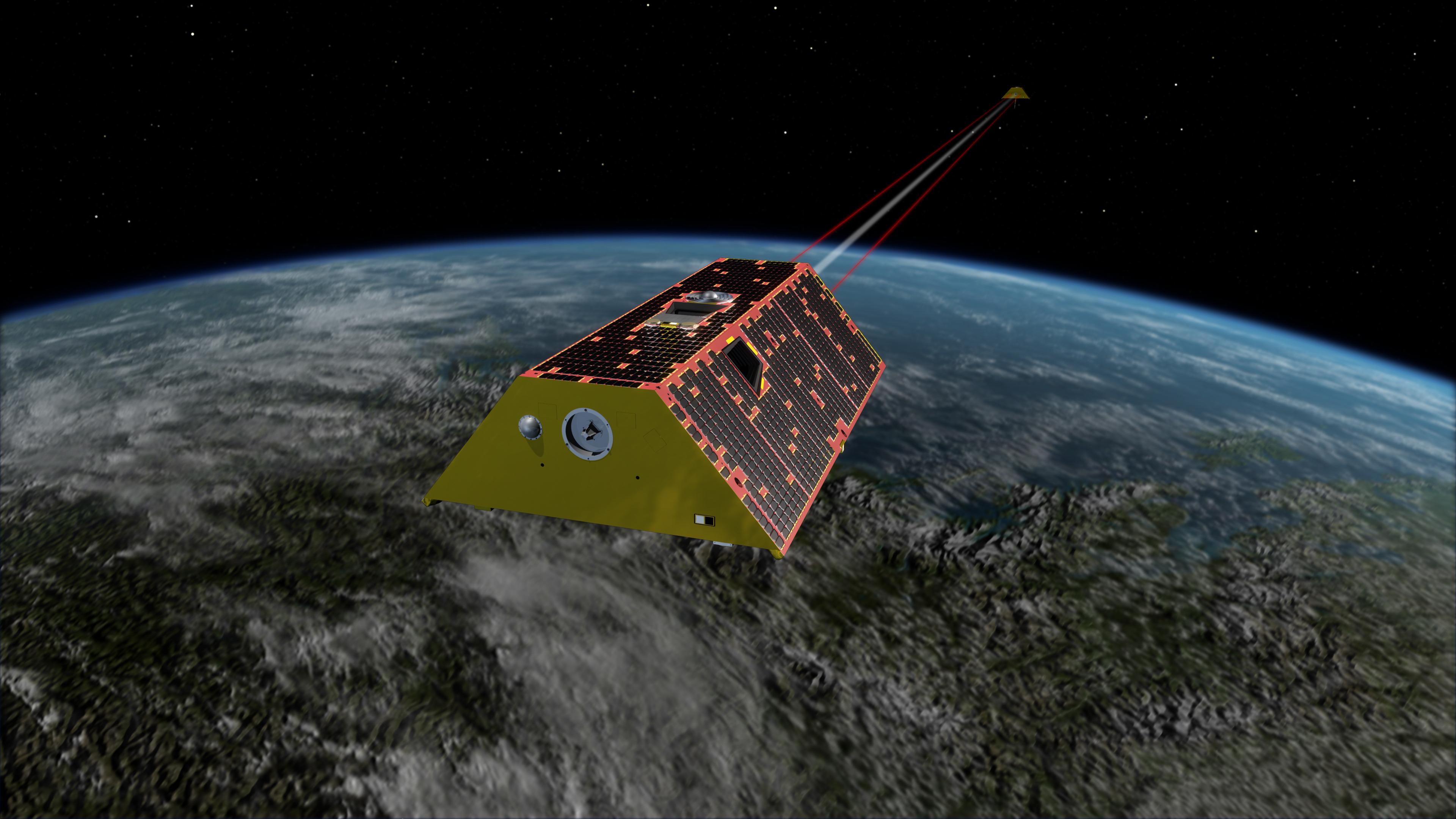
How this helps the planet: The same equations put Earth-observing satellites such as Landsat 9 and GRACE-FO into orbit, keep them pointed, and turn tiny changes in their motion into maps of water, ice and land. See Earth Observation.
- MathematicsCalculus, differential equations, linear algebra, numerical methods and statistics.7 courses
How this helps the planet: Climate scientists use derivatives to turn a record of carbon dioxide or sea ice into a rate of change, engineers use optimization to get the most energy from wind and the most mission from every kilogram of rocket fuel, and integrals add up power into energy. See ice.
- Engineering CoreCAD, programming, mechanics, circuits, thermodynamics, fluids and heat transfer.9 courses
How this helps the planet: Better cycles, recovered waste heat and heat pumps are some of the fastest ways to cut emissions. See Sustainable Aviation.
- ChemistryAtoms, reactions, bonding, gases and energy, with labs.1 course
How this helps the planet: Chemistry sits behind many of the solutions on Saving Planets: measuring greenhouse gases from orbit, testing water, turning CO₂ into stone, and building cleaner fuels and rockets. See Earth Observation.
No studies match.
More ways to learn
Find pages by standard
- Orbits Explained HS-ESS1-4, HS-PS2-4, MS-PS2-4
- Orbital Mechanics Math, Step by Step HS-ESS1-4, HS-PS2-4, HS-PS2-2, HSF-LE.A.4, AP1 Unit 2, AP1 Unit 4, IB D.1, IB A.2
- Orbit Lab HS-ESS1-4, HS-PS2-4
- How Flight Works HS-PS2-1, MS-PS2-2
- Aeronautical Engineering Math, Step by Step HS-PS2-1, HSA-CED.A.4, AP1 Unit 8, AP2 Unit 14
- Aero Lab HS-PS2-1, MS-PS2-2
- Physics Explained HS-PS2-1, MS-PS2-2, HS-PS3-1
- Physics, step by step HS-PS2-1, HS-PS3-1, HSG-SRT.C.8, AP1 Unit 1, AP1 Unit 3, AP1 Unit 7, IB A.1, IB A.3, IB C.1
- Physics Lab HS-PS2-1, MS-PS2-2
- Delta-v Calculator (Tsiolkovsky Rocket Equation) HS-PS2-2, HSF-LE.A.4, AP1 Unit 4, IB A.2
- Hohmann Transfer Calculator HS-ESS1-4, AP1 Unit 2, IB D.1
- Orbital Period Calculator HS-ESS1-4, AP1 Unit 2, IB D.1
- Orbital Velocity & Escape Velocity Calculator HS-ESS1-4, HS-PS2-4, IB D.1
- Stall Speed Calculator (with Bank Angle and Altitude) HS-PS2-1, HSA-CED.A.4, AP1 Unit 8
- Lift Equation Calculator HS-PS2-1, HSA-CED.A.4, AP1 Unit 8
- Mach Number & Speed of Sound Calculator (Standard Atmosphere) AP2 Unit 14, HSN-Q.A.1
- Thrust-to-Weight Ratio Calculator HS-PS2-1, AP1 Unit 2, IB A.2
- Rotor Hover Power Calculator (Momentum Theory) HS-PS3-1, AP1 Unit 3, IB A.3
- Projectile Motion Calculator with Air Resistance HS-PS2-1, HSG-SRT.C.8, AP1 Unit 1, IB A.1
- Pendulum Period Calculator (Small and Large Angles) AP1 Unit 7, IB C.1, HSA-CED.A.4
Our alignment; not reviewed by the standards bodies.
People also ask
What can I learn for free on Saving Planets?
Eight free studies: rocket propulsion, jet propulsion, aeronautical engineering, orbits, physics, mathematics, engineering core and chemistry. K-12 guides for aeronautical engineering, orbits and physics; university courses in every study.
Source: Learn · On this site
What is in the Tracks learning path?
Pair the guide with the Orbit Lab in class, and use the Lesson Builder and teacher sheets to plan.
Source: Tracks · On this site
What is in the Orbital Mechanics learning path?
How satellites and spacecraft move: Kepler, vis-viva, transfers, perturbations and Lambert targeting.
Source: Orbital Mechanics · On this site
What is in the Aeronautical Engineering learning path?
How aircraft fly: lift and drag, airfoils, propulsion, performance, stability and control of high-performance jets and rotorcraft.
Source: Aeronautical Engineering · On this site
What is in the Physics learning path?
The foundations: classical mechanics, Lagrangian and Hamiltonian mechanics, electromagnetism, thermodynamics and statistical mechanics, fluids, and the relativity that matters for orbits.
Source: Physics · On this site
What is in the Levels learning path?
Pair the guide with the Orbit Lab in class, and use the Lesson Builder and teacher sheets to plan.
Source: Levels · On this site