Hera
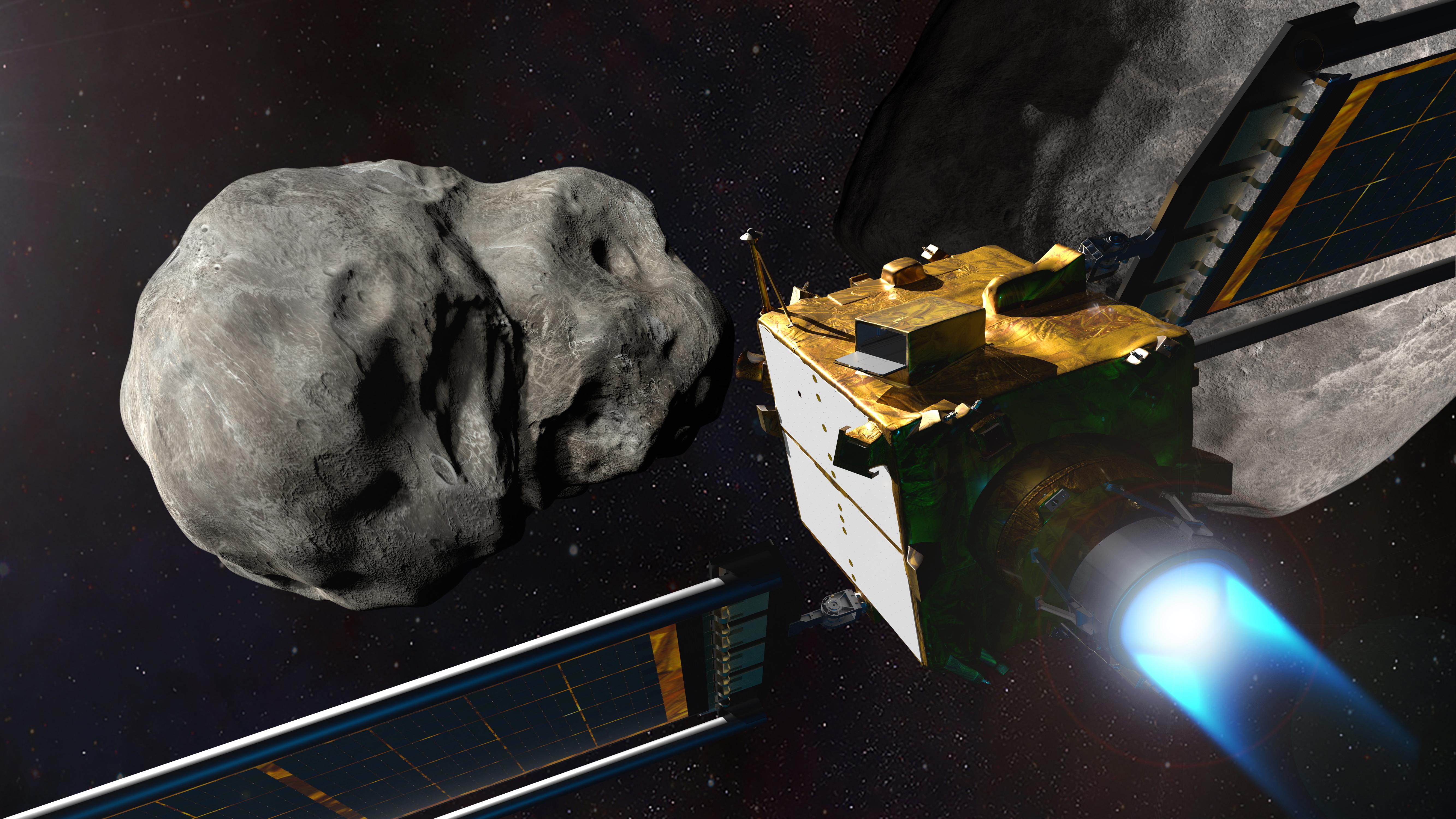
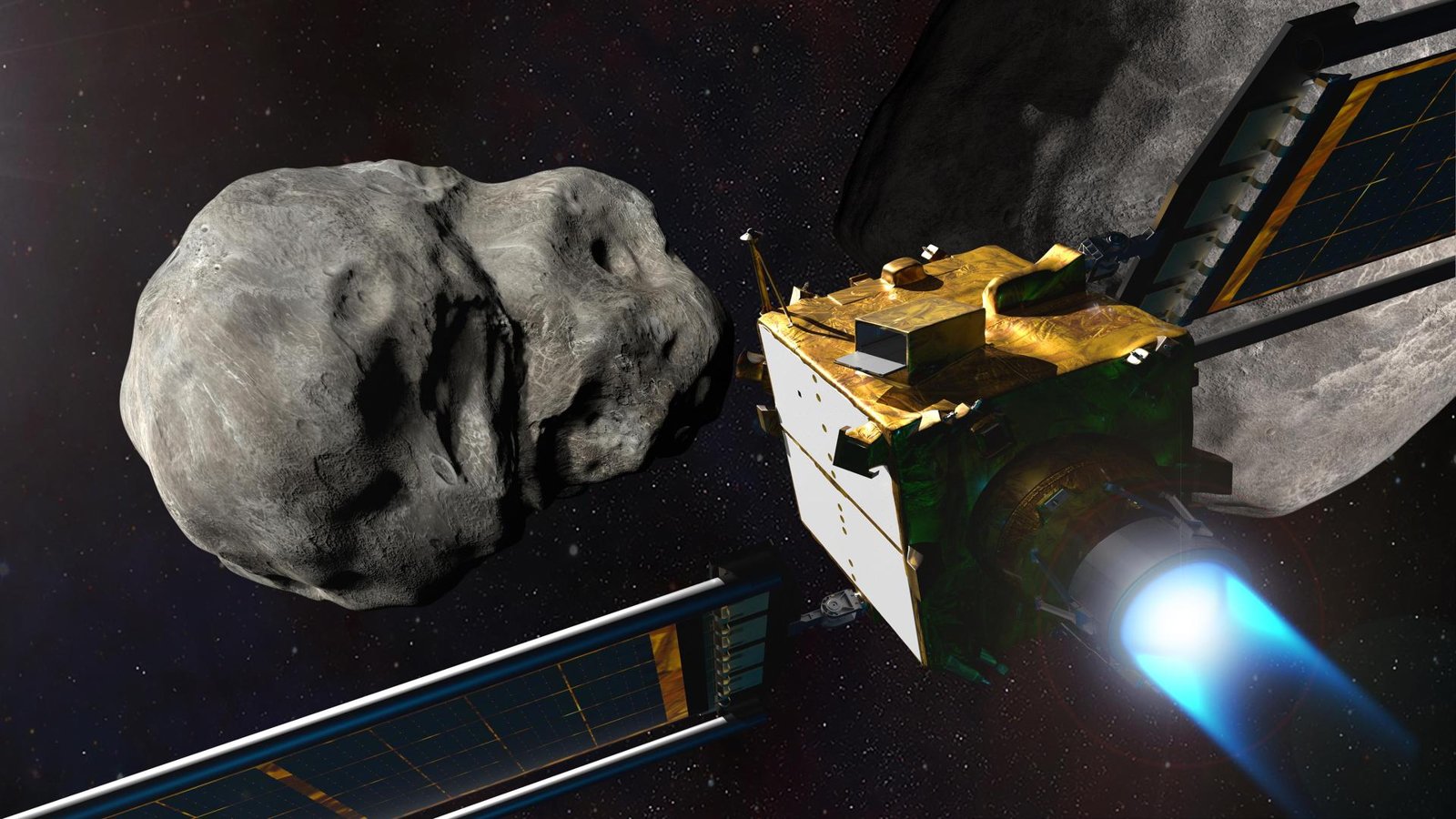
Crash scene investigators for the first asteroid humans ever moved.
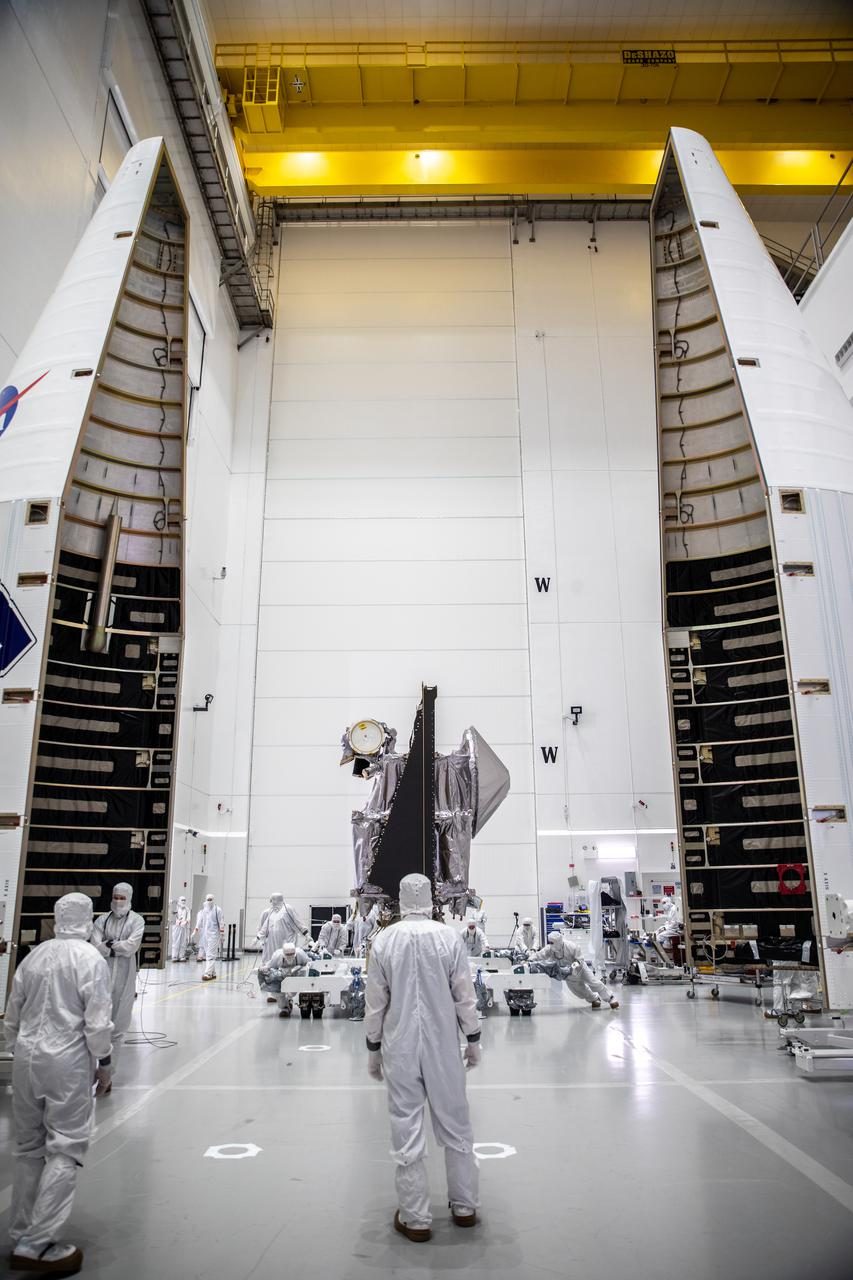
Image: ESA – Science Office, CC BY-SA 3.0 IGO. Resized from the original.
Last reviewed: 7 sources cited
Explain Like I'm 10
- What is it? A small, van-sized deep-space spacecraft that will perform a close-up "crash scene investigation" of Dimorphos, measuring its mass, its shifted The curved path an object takes as it travels around a planet, moon or star, like a satellite circling Earth. Glossary and DART's impact crater. Juventas will make the first A tool that sends out radio waves and listens for the echoes. From space it can see the ground through clouds, day or night. Glossary sounding inside an A rocky object that orbits the Sun, much smaller than a planet. Most are in a belt between Mars and Jupiter. Glossary.
- Why does it matter? To turn DART's one-off hit into a well-understood, repeatable technique for defending Earth from hazardous asteroids, by measuring how much push the impact really delivered.
The Five W's of Hera
Who
The European Space Agency, through its Space Safety programme, working with NASA under the international AIDA collaboration. Hera carries two CubeSats: Milani and Juventas.
Source: ESA, Hera mission overview
What
A small, van-sized deep-space spacecraft that will perform a close-up "crash scene investigation" of Dimorphos, measuring its mass, its shifted orbit and DART's impact crater. Juventas will make the first radar sounding inside an asteroid.
Source: ESA, Hera mission overview
When
Launched October 7, 2024. Hera has now arrived: ESA confirmed on November 11, 2026, that it is flying 25–30 km from Didymos and Dimorphos and has begun its early characterisation phase. ESA says detailed images of both asteroids will be unveiled on November 25, 2026. A deep-space burn in early 2026 used 123 kg of fuel and changed its speed by 367 m/s.
Source: ESA, Hera arrives at its target asteroids (11 Nov 2026)
Source: ESA, Hera targets early arrival
Where
The Didymos binary asteroid system. Didymos is 780 m across; its moon Dimorphos is 151 m, about the size of the Great Pyramid of Giza.
Source: ESA, Hera mission overview
Why
To turn DART's one-off hit into a well-understood, repeatable technique for defending Earth from hazardous asteroids, by measuring how much push the impact really delivered.
Source: ESA, Hera mission overview
Impact Statement
On September 26, 2022, NASA's DART spacecraft deliberately crashed into Dimorphos. NASA first announced the moonlet's 11-hour-55-minute orbit was 32 minutes shorter; refined analysis puts the final change at 33 minutes and 15 seconds.
It was the first time humanity purposely changed the motion of a celestial object.
Source: NASA, Didymos and Dimorphos
Source: NASA, Asteroid's orbit, shape changed after DART impact
The Hubble Space An instrument that collects light (or other energy) to see faraway things more clearly. Glossary then spotted 37 boulders, 1 to 6.7 meters across, drifting away from Dimorphos at about 1 km per hour, together about 0.1% of its mass. These are exactly the kind of loose pieces Hera will study up close.
Source: NASA, Hubble sees boulders escaping from Dimorphos
What Hera Adds
Dimorphos's mass, internal structure and crater shape are the missing pieces needed to calculate how efficiently DART transferred momentum. Hera's maps will make kinetic impact a tool that could one day be used for real.
Source: ESA, Hera mission overview
Want to go deeper? ESA's Hera pages have the mission timeline, videos and the latest images.
 For further information
Related Solutions
More solutions like this one, matched by meaning.
For Teachers
Discussion questions
- What is Hera, and what problem does it help solve?
- Who is behind Hera, and where does the work happen?
- How does Hera help both people and nature? Use one fact from this page.
Sources are listed with each fact in the Five W's above.
Standards Alignment
U.S. Next Generation Science Standards (NGSS) and Common Core. Official text, in English.
- 4-ESS3-2 (Grade 3-5) Generate and compare multiple solutions to reduce the impacts of natural Earth processes on humans.
- MS-ESS1-3 (Grade 6-8) Analyze and interpret data to determine scale properties of objects in the solar system.
- MS-ESS3-2 (Grade 6-8) Analyze and interpret data on natural hazards to forecast future catastrophic events and inform the development of technologies to mitigate their effects.
- HS-ESS1-4 (Grade 9-12) Use mathematical or computational representations to predict the motion of orbiting objects in the solar system.
- CCSS RST.6-8.1 (Grade 6-8) Cite specific textual evidence to support analysis of science and technical texts.
Cite This Page
APA
Saving Planets. (n.d.). Hera. https://www.savingplanets.com/Hera.html
MLA
"Hera." Saving Planets, https://www.savingplanets.com/Hera.html.