MicroCarb
CNES launched the MicroCarb microsatellite on the night of 25–26 July 2025 to measure carbon dioxide in the air to about 1 part per million.
Image: Tiraden, via Wikimedia Commons (CC BY-SA 4.0). A model of MicroCarb on display, not the satellite in orbit.
Last reviewed: 1 source cited
Explain Like I'm 10
- MicroCarb is a small satellite that measures carbon dioxide in the air.
- It launched in July 2025 and flies about 650 kilometers up.
- It can see CO₂ down to about 1 part per million, in boxes a few kilometers wide.
The Five W's of MicroCarb
Who
MicroCarb is a CNES mission. Partners named by CNES include CNRS, CEA, Météo-France, universities, the European Union and ESA, and the UK Space Agency.
Source: CNES, MicroCarb
What
The satellite measures carbon dioxide in the atmospheric column to about 1 part per million, with pixels of 4.5 km by 9 km at the equator.
Source: CNES, MicroCarb
When
MicroCarb launched on the night of 25–26 July 2025. CNES lists a 5-year lifetime.
Source: CNES, MicroCarb
Where
It flies a sun-synchronous orbit at 650 km. The satellite weighs 180 kg and repeats its ground track every 25 days.
Source: CNES, MicroCarb
Why
Carbon dioxide is the main greenhouse gas the mission is built to map, so scientists can see how it is distributed around the world.
Source: CNES, MicroCarb
Impact Statement
Agency solution · active
MicroCarb measures CO₂ to about 1 part per million, in 4.5 by 9 kilometer pixels, from a 650 km orbit.
Source: CNES, MicroCarb
MicroCarb is a 180 kg satellite in a 650 km sun-synchronous orbit, with a 5-year lifetime and a 25-day revisit.
How This Saves People & the Planet
For People
A global CO₂ map at about 1 part per million is a check on where carbon dioxide is building up in the air people breathe and on the climate that air shapes.
Source: CNES, MicroCarb
For Nature
The 4.5 by 9 kilometer pixels are small enough to show patterns of CO₂ across forests, cities, and oceans, and the satellite comes back over the same places every 25 days.
Source: CNES, MicroCarb
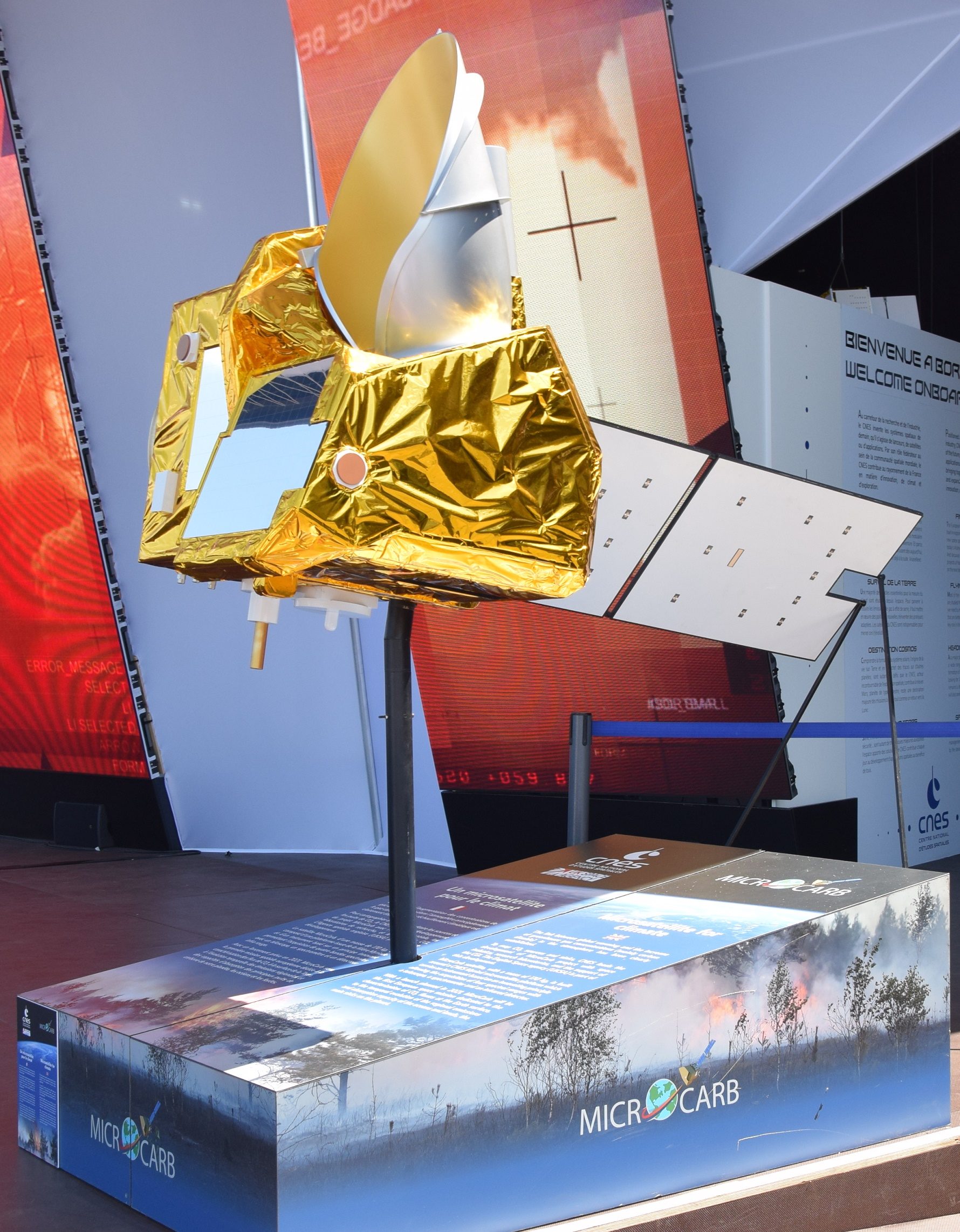
Image: Tiraden, via Wikimedia Commons (CC BY-SA 4.0). A model of MicroCarb on display, not the satellite in orbit.
Learn About MicroCarb
Want to go deeper? The CNES project page has the 25–26 July 2025 launch and the instrument’s accuracy.
For Further InformationHelp This Work
This is a CNES mission, so there is no donate button. The project page has the launch night, the orbit, and the 1 part per million figure.